Learn English w/ Grammar Games
- 4.3
- Rating
- 50.00K
- Installs
- $6.49
- Price
 Analysis by App-foxy
Learning English grammar can feel abstract when it is reduced to rules on a page. Learn English w/ Grammar Games takes a more active route: I build sentences by placing prepositions where they belong, then use the result as a small grammar exercise. After spending time with it, my impression is clear: this is a focused educational game that works best as a short, deliberate practice tool, not as a complete English course.
That distinction matters. The game is made by Gamiak and sits in the educational category, with a 4.3 average from around 475 ratings and more than 50K installs. It costs $6.49, so I would not recommend buying it casually just because the store description sounds useful. The value depends on whether you specifically want practice with sentence structure and prepositions. For that audience, the narrow focus is its main strength. For someone expecting vocabulary lessons, conversation training, pronunciation work, or a broad curriculum, it will feel limited.
How the sentence-building approach feels in practice
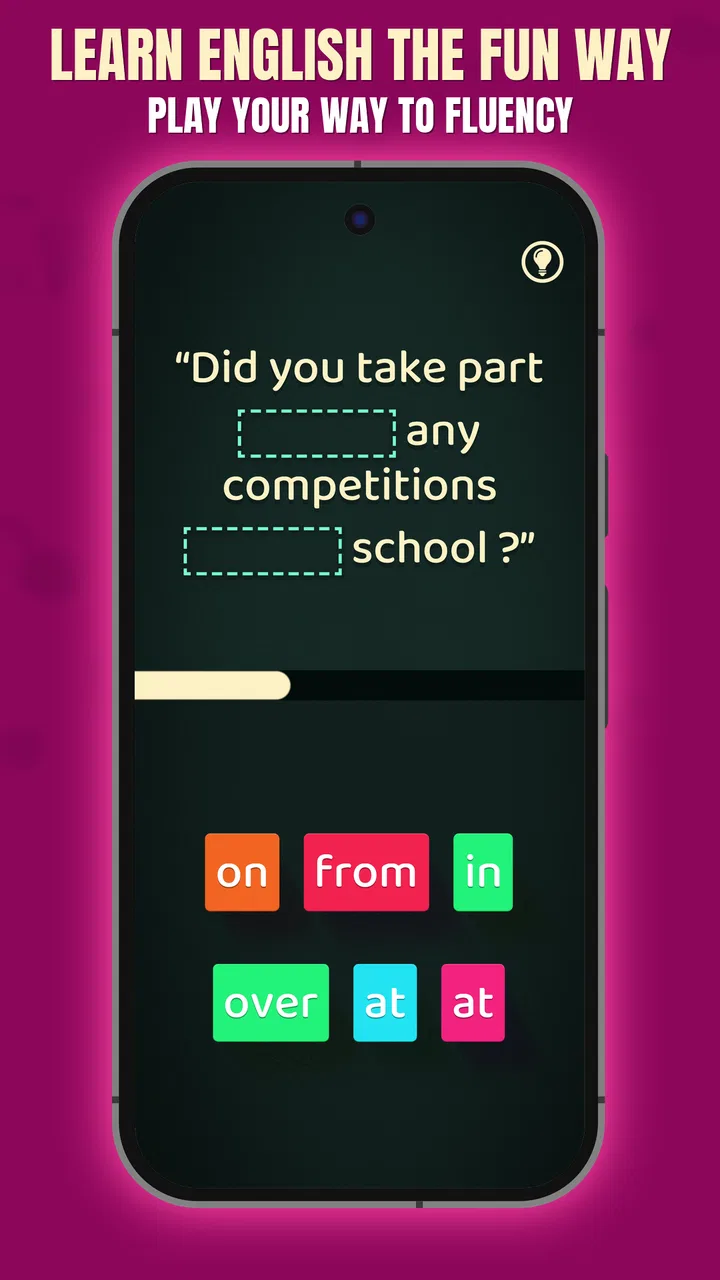
The central activity is simple to understand. A sentence contains a missing or misplaced preposition, and I have to put the correct word in position to make the sentence work. That makes the lesson more active than reading an explanation and tapping “next.” I have to consider the relationship between words, the intended meaning, and the grammar of the whole sentence before committing to an answer.
You May Also Like

 Blood Strike: 2.5 Anniversary
Blood Strike’s Loadouts Turn Every Drop Into a Tactical Gamble
A close look at Blood Strike’s custom loadouts: how fast access to signature weapons reshapes its battle royale rhythm, rewards preparation, and narrows the gap between fights.

 Pandora - Music & Podcasts
Pandora’s Music Is Easy to Start, but Harder to Recover
Pandora’s strength is its low-effort path from a seed to a station. Its weak spot is how much confidence it asks you to place in connection, setup, and quiet recovery.

 8 Ball Pool
 Is Built on Rivalries, Rematches, and Routine
A close look at the rivalries, rematches, shared routines, and unanswered safety questions that turn a quick pool match into a persistent mobile community.

 Samsung Music
’s Quiet Strength Is Playing What You Already Own
Its reach comes less from spectacle than from dependable access to a personal library. That simplicity is both the app’s strongest retention engine and its ceiling.

 AccuWeather: Weather Radar
AccuWeather Review: A Quick, Clear Forecast for Everyday Decisions
For everyday plans, the best forecast is the one you can understand quickly. AccuWeather makes rain timing, radar, and local conditions easy to act on, with a few trade-offs.

 Hill Climb Racing
Why Hill Climb Racing Still Turns Crashes Into One More Run
A tiny car, a bumpy hill and one more upgrade: Hill Climb Racing keeps resurfacing because its simple chaos makes every near-miss feel personal.
More From Our News Desk
View All News


That small difference changes how I pay attention. In a conventional worksheet, I can sometimes guess from the shape of the exercise. Here, the sentence itself becomes the clue. I am not only asking which preposition looks familiar; I am asking whether the resulting phrase sounds natural and expresses the intended relationship. This is particularly useful for learners who know many English words but still hesitate over short words such as “in,” “on,” “at,” “for,” or “to.”
The game format also makes repetition easier to tolerate. Grammar practice can become tiring when every exercise looks like a formal test. A sentence-placement task gives each item a small puzzle quality. I found myself checking the entire sentence instead of treating the preposition as an isolated answer. That is a valuable habit because prepositions are often difficult precisely because their meaning depends on context.
One practical way to use it is as a warm-up before writing. I might spend a few minutes solving sentences, then write a short message or diary entry and deliberately look for prepositions. The game does not replace writing practice, but it helps put the relevant grammar into my attention before I use it. That workflow is more effective than playing without a follow-up activity, because it connects recognition with personal expression.
Why the narrow topic is useful
Prepositions are easy to underestimate. They are short, common words, yet a small mistake can make an otherwise understandable sentence sound unnatural. Learners often memorize vocabulary nouns and verbs while continuing to struggle with the connections between them. A focused game can expose that weak point more clearly than a general English app that jumps between many unrelated skills.
I also like that the exercise asks me to think about meaning rather than simply recall a translation. A direct translation from another language can suggest the wrong preposition, especially in expressions that do not map neatly word for word. Working with complete English sentences encourages me to notice patterns as English uses them. Over time, that can support better intuition, although it still requires repeated exposure outside the app.
Another useful detail is that sentence construction gives immediate feedback on a complete phrase. If I place a word incorrectly, the problem is not just “wrong answer”; I can examine how the whole sentence changes. I recommend pausing after mistakes instead of instantly restarting. Reading the sentence aloud, identifying the noun or verb connected to the preposition, and then trying to create a second sentence with the same pattern turns a quick error into a more durable lesson.
This is also where the app suits independent learners. I do not need a teacher beside me to explain the basic task, and the activity is concrete enough to begin without a long setup. A learner who already has elementary English knowledge can use it to notice recurring trouble spots. Someone who is completely new to English may need a separate beginner course first, because knowing the individual words in a sentence is important before the grammar puzzle becomes meaningful.
Where it fits into an everyday routine
I see the game working best in short sessions rather than as a long evening of study. For example, a learner commuting by bus could complete a few exercises before arriving at work, then keep one troublesome sentence in mind during the day. Later, they could write two original examples using the same preposition. That routine is modest, but it turns a quick game into a repeatable learning loop: solve, notice, produce, and review.
It can also help a student prepare for a specific writing task. Before composing an email, application, or school assignment in English, I would use the game to refresh common preposition patterns. I would not treat a good result as proof that the final text is correct, but the exercise can make me more alert to phrases that I usually rush through. The benefit is strongest when the learner follows the practice with real writing and checks the result using a teacher, reference, or broader language tool.
Parents may find the Everyone content rating reassuring for younger learners, but the educational value still depends on reading ability and patience. The game is not automatically suitable for every child simply because the age category is broad. A child who enjoys word puzzles may engage with it, while a learner who needs pictures, spoken examples, or a more playful story may lose interest quickly. I would try it alongside the child rather than assume that the label alone predicts a good fit.
For adults, the uncomplicated format can be a benefit. There is no need to commit to a large course before discovering whether preposition practice is relevant. I can open it when I have a small amount of time and work on one narrow weakness. That makes it more approachable than a full language-learning platform when my immediate goal is grammar repair rather than a complete study program.
What it does well, and where it falls short
The strongest part of Learn English w/ Grammar Games is its clarity of purpose. It does not try to be a dictionary, a speaking coach, and a flashcard system at the same time. The sentence-placement concept keeps attention on one of the areas where English learners commonly make persistent mistakes. Because the activity is interactive, I am encouraged to make a decision and confront it, rather than passively scan a rule.
I also think the game has good value as a diagnostic tool. If I repeatedly hesitate over the same types of sentences, I learn something about my own English. Perhaps I confuse time and place expressions, rely too heavily on translation, or recognize a phrase only when I see it but cannot produce it independently. The app cannot solve those problems alone, but it can reveal them in a more concrete way than a vague feeling that my grammar is “not good.”
There is a useful trade-off here: the focused design makes practice less overwhelming, but it also means the game cannot carry a learner very far by itself. Prepositions are only one part of grammar. Even if I become more accurate with them, I still need work on verb forms, word order, articles, sentence rhythm, listening, and speaking. Anyone buying it should think of the $6.49 price as payment for a specialized practice tool, not for a full replacement for English classes or a comprehensive language app.
The other meaningful weakness is transfer. Selecting the right preposition in a prepared sentence is not identical to choosing one while speaking spontaneously. In real conversation, I have to form the sentence, retrieve vocabulary, manage pronunciation, and respond to another person at the same time. A learner can become comfortable with the game’s exercise style yet still pause in conversation. To reduce that gap, I would always add aloud practice: after solving an item, say a new sentence using the same structure without looking at the model.
There is also a risk of guessing. Short words can sometimes appear plausible in more than one context, especially for learners who have not yet developed a feel for common expressions. If I rush through the exercise, I may remember the correct position without understanding why it works. The best approach is slower than a typical arcade game: read the whole sentence, predict the answer, place it, and explain the relationship in my own words. That extra step is where much of the learning happens.
Compared with a general language-learning app, this game is less varied but more concentrated. A broad platform is usually a better choice for someone who wants a daily path covering vocabulary, listening, speaking, and grammar together. Compared with a textbook or grammar website, this app is more inviting for quick practice, but it may offer less room for long explanations and nuanced exceptions. Compared with a teacher, it is cheaper and more convenient for repetition, yet it cannot respond to the exact mistake I make in a personal sentence.
That comparison helps clarify who should skip it. I would not choose this as my only resource if I were preparing for an exam that tests many grammar areas, trying to improve pronunciation, or looking for live conversation. I would also hesitate if I already use a structured course that gives me plenty of preposition exercises and explains my errors in detail. In those cases, the app may duplicate work rather than fill a genuine gap.
Small techniques that make the practice stronger
My first recommendation is to keep an error notebook, even if it is only a note on a phone. Write the sentence pattern rather than just the answer. For instance, record the relationship being expressed and create a personal example connected to work, travel, study, or home life. This prevents the exercise from becoming a collection of disconnected correct taps.
Second, separate recognition from production. After solving a sentence, hide the original and reconstruct a similar sentence from memory. Then say it aloud with a different subject or time. This exposes whether I truly understand the pattern or merely recognized the arrangement on screen. It is one of the most important ways to compensate for the game’s limited connection to spontaneous speaking.
Third, review mistakes in groups. If several errors involve places, times, movement, or fixed expressions, practice that group together instead of treating each item as an isolated failure. The pattern may become clearer when related examples sit side by side. I would not assume that one correct answer means I have mastered the rule; I would look for consistent performance across new sentences and real writing.
A fourth technique is to use the game before, not instead of, an English task. Play briefly before reading a news article, writing an email, or joining a lesson. Then mark every preposition you notice in the outside material. This gives the exercise a real-world destination and helps me see that grammar is not just a puzzle mechanic. It is part of how English expresses time, place, direction, purpose, and relationships between ideas.
Device expectations and long-term value
The listed minimum operating system is Android 7.0, and the current version is 2.1. That makes it relevant to people using older Android devices, provided their phone meets that requirement. I still recommend checking the device’s compatibility before paying, particularly if the phone is old or has limited storage. The game’s appeal is its focused practice, so technical friction would undermine the very convenience that makes it attractive.
Its release date, Aug 5, 2017, also gives useful context. I approach it as an established, focused grammar game rather than a modern all-in-one learning platform. That is not automatically a disadvantage. A simple tool can remain useful when its core exercise matches the learner’s need. But I would not expect the breadth, presentation style, or broader ecosystem associated with newer language services. The right question is not whether it looks as expansive as a current subscription platform; it is whether its specific practice method helps me.
The public response suggests a reasonably positive reception, with around 475 ratings and 10 reviews contributing to its visible feedback. I would treat that as a sign of interest rather than a guarantee that every learner will enjoy it. Ratings cannot tell me whether the exercises match my level or whether I prefer game-based repetition. The more important test is personal: do I often make preposition mistakes, and am I willing to practice them through sentence construction?
Because it is paid, I would make that decision carefully. The price is easier to justify for a learner who has already identified prepositions as a recurring weakness and wants a dedicated activity. It is harder to justify for someone browsing for a general English app or hoping for a complete course. In the latter case, a broader alternative may provide more useful coverage, even if its grammar practice is less focused.
For teachers or tutors, I can imagine using the game as a supplement to a lesson, especially when a learner needs repeated exposure without another worksheet. I would still add explanation and personalized examples. The game can supply prompts, but a teacher can explain why a phrase sounds natural, compare near alternatives, and adapt the difficulty to the student. It works better as a practice station than as the entire lesson.
My recommendation for different kinds of learners
I would recommend it to an elementary or intermediate learner who understands basic English sentences but regularly confuses prepositions. It is also a good match for people who dislike long grammar explanations and prefer learning through small decisions. A student who wants a compact activity before homework, an adult refreshing English after a break, or a parent looking for a simple grammar-focused exercise may all find a reasonable use for it.
I would recommend caution to advanced learners. The app may still be useful for checking persistent weak points, but advanced users may need more challenging material involving nuance, register, idioms, editing, and free composition. If the task feels too easy, the learner should move quickly from the game to authentic articles, essays, and conversation rather than repeating familiar items for a sense of progress.
For complete beginners, I would use it only after learning enough vocabulary to understand the sentences. Prepositions are difficult when the surrounding words are unfamiliar, and guessing every answer will produce little benefit. A beginner course with audio, pictures, basic vocabulary, and guided explanations is likely to be a better first step. This game becomes more useful once the learner can focus on the grammatical relationship instead of decoding every word.
For a learner with a clear exam goal, I would pair it with exam-specific material. It can sharpen one component of grammar, but exams also require reading speed, writing organization, vocabulary range, and sometimes listening or speaking. The game should support that preparation, not define it. The same is true for job-related English: use it to polish recurring sentence problems, then practice the phrases that belong to the actual workplace.
My final take
After using it as a focused practice tool, I see Learn English w/ Grammar Games as a specialized purchase with a sensible educational idea. Its best quality is that it turns prepositions into something I actively solve, not merely something I read about. That makes short practice more engaging and gives me a practical way to identify errors that often hide inside otherwise understandable English.
Its limitations are equally important. It is not a full language course, it cannot replace real conversation, and the learner must add explanation and production practice to move beyond recognition. The paid price makes the narrow focus a serious consideration, especially when broad alternatives may cover more skills. I would skip it if my main goal were pronunciation, vocabulary growth, or a complete study plan.
For the right person, though, the focus is exactly the point. If prepositions are the part of English that repeatedly slows you down, this game offers a clear routine: solve the sentence, study the relationship, create your own example, and use it in real writing or speech. Gamiak’s app is best viewed as a compact grammar trainer, and within that role it can earn its place in a learner’s routine. The Everyone rating makes it broadly accessible, the Android 7.0 requirement supports older devices, and version 2.1 keeps the product identifiable for installation decisions. My recommendation is positive but specific: buy it for targeted preposition practice, not because you expect one game to teach you English from beginning to end.
FAQs for Learn English w/ Grammar Games
01What is Learn English w/ Grammar Games?
Learn English w/ Grammar Games is an educational app designed to help users practice English grammar through short, interactive exercises and game-style challenges. Instead of relying only on traditional explanations, it encourages learning by answering questions, reviewing mistakes, and progressing through different activities. It may be useful for beginners and intermediate learners who want a more engaging way to reinforce grammar rules on a mobile device.
02Which English grammar topics can I practice in the app?
The app generally focuses on essential grammar areas that English learners commonly need, such as verb tenses, articles, prepositions, pronouns, sentence structure, adjectives, adverbs, and question formation. The exact topics and difficulty levels can vary depending on the version installed. Users should explore the available categories first, because the app may be better suited to foundational practice than to advanced academic or professional grammar study.
03Is Learn English w/ Grammar Games suitable for beginners?
Yes, the game-based format can be suitable for beginners, particularly users who are still building confidence with basic English sentences and grammar rules. The short activities make it possible to study in small sessions without feeling overwhelmed. However, learners who have very limited English may still benefit from using a dictionary, translation tool, or separate pronunciation course, since grammar games may not explain every answer in extensive detail.
04Can I use the app offline, and does it require an account?
Offline access and account requirements depend on the app version, device, and the way its content is delivered. Some grammar exercises may work without a constant internet connection after installation, while advertisements, updates, synchronization, or certain features may require connectivity. Before downloading, check the current Google Play or App Store listing for information about login requirements, offline support, permissions, and whether progress can be saved across multiple devices.
05Is Learn English w/ Grammar Games free to download?
The app may be available as a free download, but free access does not always mean that every feature is included without limitations. Depending on the platform and release, users may encounter advertisements, locked lessons, optional purchases, or premium content. It is worth reviewing the store page before installing and checking the in-app purchase section, especially if the application will be used by children or on a shared family device.
Pros
- Short grammar games make practice feel less repetitive.
- Covers several common English grammar topics for beginners.
- Quick exercises fit easily into short daily study sessions.
- Immediate feedback helps identify mistakes while practicing.
- Useful as a supplementary tool alongside classes or textbooks.
Cons
- Content may feel too basic for intermediate or advanced learners.
- Repeated exercises can become predictable after extended use.
- Game-based practice may not explain complex grammar rules deeply.
- Some features or lessons may require an internet connection.
- Progress in grammar does not replace listening and conversation practice.

Learn English w/ Grammar Games
Gallery